FAQs

The Under One Roof website has hundreds of articles on all aspects of tenement maintenance and repair management. If you have a question, make sure to read the articles first, as you may find your answer already on our website.

We analysed hundreds of enquiries to identify the most common questions flat owners have about tenement maintenance and repair management. This led us to compile a list of 15 frequently asked questions that we often receive through our ‘Ask a tenement expert’ enquiry service. 

On this page, you’ll find concise answers to these questions, along with links to relevant articles on our website for more detailed information.

  • If you’re well-organised and have a basic understanding of your building’s structure, you might be able to handle smaller repairs by yourself. However, for larger or more complex repairs, it’s advisable to seek professional assistance, as this can save you money in the long run. 

    Always check your titles before proceeding with common repairs. 

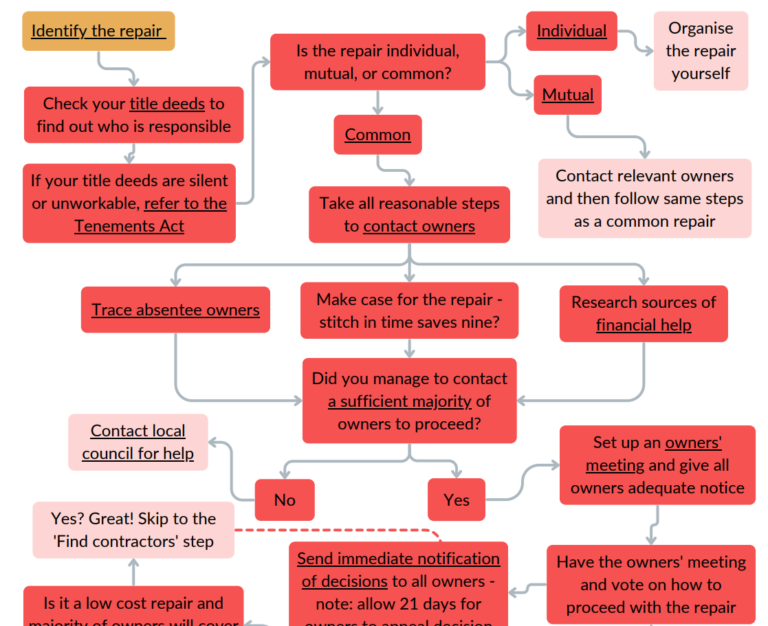
    Download our decisions-tree guide to help you navigate the common repairs process and ensure you’re following proper procedures. 

  • Make sure you have exhausted all options for contacting the other owners in your building before proceeding with repairs. Informing owners and getting agreement are part of proper procedures and are necessary should you need to take legal action to recover costs. 

    Try these options first: 

    • Land Register: You will be able to find the names of your co-owners on the Land Register, which will help with subsequent searching. This may involve a small fee. 
    • Register of Private Landlords: If the property is rented, you may be able to find the landlord’s details on this register. This search is free. 
    • Letting agents: The landlord search may give the name of a letting agent. A letting agent is required to respond to appropriate third-party enquiries, especially those related to statutory repairing or maintenance obligations. You might also be able to find out the details of the letting agent from the tenant/s. 
    • Post a letter: If you cannot contact an owner directly, you can post a letter addressed to ‘The Owner’ through the flat letterbox. It’s a good idea to have another neighbour witness this action and take a video recording as evidence. 
    • Council assistance: Your local council may be able to send a message to the person registered as the property owner on the Council Tax Register.  
    • Online search: Try searching online if you know the owner’s name. Social media platforms like Facebook might provide a way to contact them. Ensure you keep screenshots of any communications for your records.  

    Check out our Useful contacts article for further contact information.

    If you are carrying out an expensive repair and need all owners to contribute, you could also try the following: 

    • Empty home: If you suspect a flat is empty, reach out to your council’s Empty Homes Officer if they have one, or if they don’t, contact the Scottish Empty Homes Partnership for assistance.  
    • Professional help: If other methods fail, you might consider hiring a sheriff officer or a private detective, although this can incur additional costs. 

    If you have taken all reasonable steps and the repair work that is needed is urgent, you may be able to follow emergency repair procedures. 

    If the repair is not an emergency repair, and the majority of owners in the building have agreed to the repair, you may decide to go ahead and recover the costs at a later date, providing you can evidence that you have taken all reasonable steps to contact the owner. 

    If the cost is under £5000, you can look to use the Simple Procedure to recover costs. 

    If the cost is over £5000, you will need to use an Ordinary Cause action which will require a solicitor. 

    If the repair is not an emergency repair, and you do not have majority agreement from the owners in your building to go ahead, see our article on enforcing repairs yourself for the options available. 

  • To determine if you are responsible for a repair, you should first check your titles. Your titles will outline the specific rules and responsibilities for your building. See our property rules and title deeds toolkit for more information. 

    If your titles do not provide a clear answer, you must follow the default rules in the Tenements (Scotland) Act 2004.  

    According to the Tenements Act, common repairs are for parts of the tenement termed “scheme property”, which include: 

    • (a) any part of the tenement which is owned in common, either under the title deeds or the Tenements Act (a typical example is the close and stairs);
    • (b) any part of the tenement which has to be maintained in common under the title deeds; and 
    • (c) and the following parts of the tenement (for most of the default rules – even if they are not owned or maintained in common): 
      • the ground (solum) on which your building stands (but not the garden) 
      • the foundations 
      • the external walls 
      • the roof (including the rafters or other supporting structure) 
      • other structural parts of the building, such as beams, columns, and loadbearing walls 

    For example, if the repair involves an external wall, it is typically a common responsibility shared by all owners. If it is an internal issue within your flat, it is likely to be your individual responsibility. 

    If your titles are unclear and there is a dispute over who is responsible for a repair, it is recommended to seek advice from a solicitor. 

    See this FAQ to find out if someone be forced to pay for a repair that was carried out without their being informed/asked for consent. 

  • You have a few options: 

    • using the Duty to Maintain 
    • serving a Notice of Potential Liability 
    • following emergency repair procedures 
    • seeking assistance from your local council 

    See this article for more information about these options and the steps you can take. 

  • It is unlikely that you will be able to force an owner to pay for a repair if they were not informed of the repair prior to it being carried out (unless it was an emergency repair or enforceable under the Duty to Maintain). 

    The Tenements (Scotland) Act 2004 provides specific rules about how repairs should be agreed upon and carried out. Generally, for non-emergency repairs, a majority decision is required, and all owners should be informed and given the opportunity to consent to the repair costs. 

    Owners who disagree with a majority decision on the grounds that it is not in the best interests of all owners or is unfairly prejudicial to one owner can appeal to the Sherrif Court. Otherwise, minority owners must go ahead with the majority decision. 

    See Enforcing repairs yourself for more information. 

  • If some owners won’t pay their share of costs and the repair work has already been carried out, you have a few options: 

    If the repair work has not started, contact your council to see if they have a Missing Shares Scheme. 

  • If some owners are unable to pay, it’s advisable to discuss the situation with all owners to try and find a mutually agreeable solution. It is also a good idea to reach out to a local money advice centre and contact Citizens Advice for help. 

    Sometimes, owners can come to an informal agreement to adjust the payment terms or find alternative ways to cover the costs – e.g. 7 out of 8 owners may decide to cover the remaining share between them. 

    If the repair work has not started, you may be able to use Missing Shares if your council has a Missing Shares Scheme. The owner will still have to repay the council. 

    You may also decide to serve a charging order to enable costs to be recovered when the flat is sold. Contact your local council for further information about this. 

  • First, check your titles to see if they provide guidance on what to do in an emergency situation. If they do not, the Tenements (Scotland) Act 2004 states that any owner can instruct emergency work and recover the costs from the other flat owners in the building. 

    Emergency repair procedures can be used when: 

    • the work is both urgent; and 
    • work needs to be carried out before all other owners can be consulted.

    If your repair meets both these criteria, proceed with the repair. 

    Where possible, have a surveyor or technical expert assess the problem immediately. Their evaluation could be helpful if legal action is needed to recover costs from owners who are unwilling to pay their share. 

    Once the repair is completed, notify the other flat owners in writing, explaining the emergency measures taken, and include detailed information about the repair when sending the bill.  

    If a flat owner in the building is refusing to pay their share of an emergency repair, it’s important to first have a conversation to understand the reason behind their refusal. Is it that they won’t pay or can’t pay? 

    See this FAQ if it’s the case that owners are unwilling to pay their share. 

  • First, check your titles to see if they state how to share repair costs. Use our property rules and title deeds toolkit for information on how to find them and what to look for. 

    If your titles are unclear or don’t add up, the default rules in the Tenements (Scotland) Act 2004 should be followed. See this article for how to share repair costs according to the Tenements Act. 

    If there are disputes over sharing repair costs, it’s advisable to seek advice from a solicitor. 

  • If the majority of owners decide to carry out a patch repair, then this is what you will have to do, even if it makes financial sense to carry out a better-quality repair that will last much longer than a patch repair.

  • An owner is responsible for the cost of repairs from the date when: 

    • a scheme decision is made to incur repair costs (the meeting date) or when the owner is given notice of a decision being properly made to carry out repairs; or 
    • from when emergency work is instructed; or 
    • from when the factor instructs work; or 
    • for maintenance, from the date on which the maintenance is completed (Tenements (Scotland) Act 2004 s11).

    The previous owner is responsible up until the time the conveyance of the flat is completed, and the new owner is responsible after that date. 

    If the previous owner has moved, then owners as a group should make efforts to find them and recover costs. If they are unsuccessful in this, then they need to share the cost between the owners who were there when the decision was made. 

    Sometimes, it can take some time to fully set up the process of commissioning and completing repairs, so owners should protect their position by registering a Notice of Potential Liability for Costs (NoPL). This makes both the previous owner and the new owner responsible, and the cost will get sorted out during the conveyance. 

  • All flat owners are legally required to have building insurance. First check your titles as they may require you to have a block insurance policy. Additionally, consult with your lender – most will allow you to choose a suitable block policy. 

    If you do have a choice between an individual policy or a block policy, verify that you can obtain a block policy – you may need to go through a broker. 

    Discuss your options for insurance with your co-owners. All owners should be informed and consulted before going ahead with a block policy. 

    Finally, compare the costs and benefits to ensure you’re selecting the best option. 

    See our article on building insurance to find out what to look for in a policy. 

  • Commissioning repairs can be a lengthy process as investigations into what is required will need to be made and then repair firms commissioned. 

    Unless the factor has a float or an agreed delegation, they will want to get agreement from all owners to carry out a repair before starting. Quite often, owners will delay responding to the factor or won’t agree, in which case the factor will generally not commission the repairs.   

    A good factor will keep you updated on the progress of a repair, but it is always worth contacting the factor and asking them for a progress report and asking them to keep chasing up owners. 

    If you feel the factor is being unduly slow, use their complaints procedure. 

    The factor is prevented by Data Protection rules from telling you which owners have not yet agreed to repairs. If you want to speed up progress, you can contact owners individually yourself to emphasise why repairs are essential. If you find a small minority of owners will not agree, then have a conversation with the factor about what can be done to make up missing shares – which could involve all owners who have agreed covering the missing shares between them, asking for help from your local council or the factor agreeing to take legal action against defaulting owners on behalf of the group. 

    See Resolving problems with factors.

  • An owners’ association is a formal agreement between all the owners to come together and manage their building. Often a committee of owners will volunteer to act on everyone’s behalf. A good committee will follow the rules in the owners’ association constitution and report back to other owners to ensure they are doing what the majority of owners have decided. This can be hard and unrewarding work, so you should give the committee your support. If you feel they are going beyond their remit, ask them to hold an owners’ meeting to confirm a way forward that suits the majority.

    See this article for information about owners’ associations. 

    See this guide for how to set one up in your building. 

  • Use the search function to try and find what you’re looking for. Alternatively, use our ‘Ask an expert’ enquiry service to receive a tailored response to your question.

Ask for help from our team of tenement experts

Managing and maintaining a tenement building can be difficult. Under One Roof offers a free enquiry service that allows you to ask specific questions relating to your building.

Ask an expert
Newsletter
Privacy policy
Terms of service

Mid ceiling

Stone in Scotland: Past, Present and Future, A Seminar with Historic Environment Scotland

The first short talk of the day was delivered by architect Ingvar Maxwell, who explored the history of stone in Scottish buildings from the prehistoric age until the 20th century. He explained how…

1729 1257 Under One Roof

Buying and selling flats with cladding

Mortgage lenders now require that those buying flats with cladding to provide…

406 305 Under One Roof

Below ground level

Your tenement may have a basement, sometimes used for living accommodation or…

905 800 Under One Roof

Guide to energy efficiency improvements

Insulation, draught-proofing and improved glazing can save money, improve comfort and reduce…

2560 1707 Under One Roof

Insulating traditional solid walls

Recent research suggests that traditional solid stone or brick walls provide better…

2560 1707 Under One Roof

Attendance to Navigating tenement building repairs with East Lothian Council Event on 5th September

Please complete the following to confirm your attendance.

5th September - Navigating tenement building repairs
Privacy policy
Terms of service

Attendance to Preserving our tenements with East Lothian Council and Dunbar CARS on 12th September

Please complete the following to confirm your attendance.

12th September - Preserving our tenements
Privacy policy
Terms of service

Subscribe to our newsletter

Sign up to our newsletter to receive regular updates and articles on events, tenement maintenance and management, retrofit and energy efficiency, policy updates, and other tenement-related news.

Newsletter Signup
Privacy policy
Start typing
Privacy Preferences

When you visit our website, it may store information through your browser from specific services, usually in the form of cookies. Here you can change your Privacy preferences. It is worth noting that blocking some types of cookies may impact your experience on our website and the services we are able to offer. When you have made your selection please save preference and select I agree.

Our website uses cookies, mainly from 3rd party services. Define your Privacy Preferences and/or agree to our use of cookies.