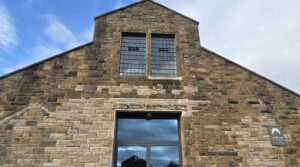
In February 2026, Under One Roof staff attended a hybrid seminar on the use of stone in building construction in Scotland, held by Historic Environment Scotland (HES) at The Engine Shed in Stirling. The Engine Shed is HES’ dedicated building conservation centre, which hosts labs, exhibits and events supporting the heritage sector and preserving Scotland’s built heritage. The seminar began with a series of three short lectures, and was followed by an exciting walking tour around Stirling to look at the city’s use of stone in real life.
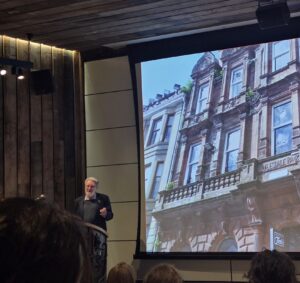
The first short talk of the day was delivered by architect Ingvar Maxwell, who explored the history of stone in Scottish buildings from the prehistoric age until the 20th century. He explained how stone became Scotland’s primary building material due to its availability across the country, and how the availability of different kinds of stone in different areas has shaped the unique aesthetics of our towns, cities and historic monuments. While the many varieties of stone have distinctive properties, each type requires maintenance and repair at some point throughout its use as a building material, particularly in a country with such a rainy climate. “Water,” Ingvar explained, “is the enemy of stone.”
As climate change worsens and rainfall increases, the need for more dedicated stone repairs and maintenance work will increase too. Ingvar made a passionate appeal for Scotland’s traditional stone buildings to be preserved, which is only possible through the passing down of traditional skills and knowledge of stonemasonry.
The second talk was given by Callum Graham, a conservation scientist who specialises in stone matching. When conducting stone repairs in a historic building, it is crucial to ensure that the new stone matches the old one as closely as possible. This is an exact science, called ‘petrographic analysis,’ which relies on tiny samples of stone examined under a microscope. Conservation scientists will consider the grain size, mineral components and porosity of a piece of stone when considering a good match, and then attempt to source stone from the same or a nearby quarry. To help them do this, HES and the British Geological Survey have worked together to create the Building Stone Database for Scotland, which provides details of quarries, built sites and samples of every type of stone used for building. Callum explained that a shortage of quarries, as there are now fewer than 15 still operating in Scotland, makes accurate stone matching challenging.
The final lecture of the day was given by Chuck Jones, a Technical Skills Manager at HES. He discussed stonemasonry repairs, and the causes of decay in stone. The causes of decay can be either intrinsic, due to the stone’s natural properties such as sandstone’s porosity, or they can be external, caused by outside factors such as frost, pollutants or lichen. One major cause of stone decay is the lack of movement of moisture through it. Stone needs to ‘breathe,’ to dry out after it has been made wet, and when it is prevented from doing so, the retained moisture can cause damage. Bad stone repair techniques such as covering stone with concrete cement prevent moisture from moving out of the stone, and exacerbate decay. Chuck also explained that modern architecture, which favours clean lines and smooth surfaces, can contribute to stone decay. The carvings and ornamental details which cover Baroque and Victorian buildings encouraged water to move and bounce off buildings, protecting the stone. On a smooth, flat surface, water has nowhere to move. He pointed the audience towards the Society for the Protection of Ancient Buildings’ guide on damp, a useful resource for understanding and tackling damp in historic buildings.
After the morning lectures and lunch, we were treated to a walking tour around Stirling, to explore how stone has been used in construction throughout the city’s history, and how it has been repaired and maintained.
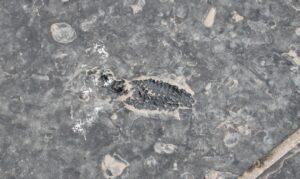
We began by examining the pavement beneath our feet, made from flagstones quarried in Caithness. At some point in its ancient history, the quarry had been covered in water, and the fossils of fish, with their distinctive spines and bone structure, are still visible in these flagstones.
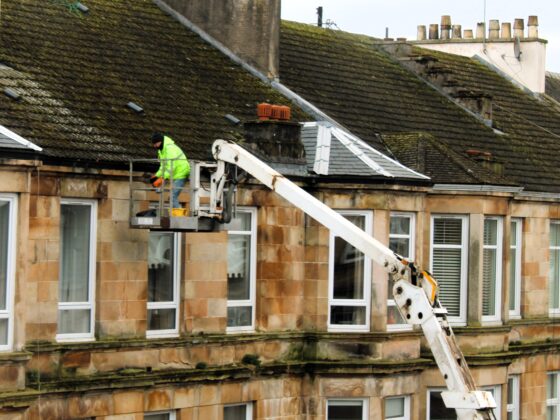
We then explored several Victorian buildings in the city’s Murray Place, constructed from blonde sandstone from local former quarries. Our guide explained that the stone is very high quality, but in the case of the former Bank of Scotland building, is suffering from neglect and a lack of maintenance. The presence of well-established greenery in the gutters and in between buildings is indicative of blocked gutters and damp.
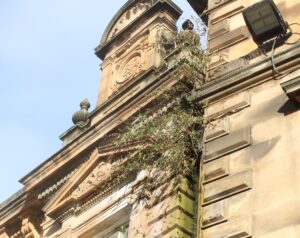
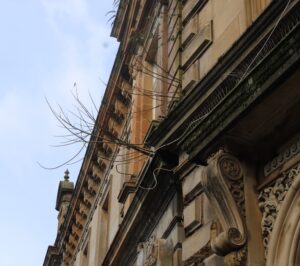
As we moved up towards the Castle, we took the time to look at the former Clydesdale Bank building, an ornate red sandstone construction which is showing signs of intense neglect and wear. Damp, once again, proves to be the culprit, as the front of the building is covered in tell-tale white efflorescence stains and greenery is growing from the gutters.

Finally, we ended the tour around Stirling Castle, looking at examples of well-maintained historic buildings. Despite mostly being constructed in the 17th century, the stone in these buildings has been protected from the impact of damp, often through a process called ‘lime harling.’ This is a technique for preserving stone walls by covering them in wet lime mortar, which dries and creates an even, weatherproof coating.
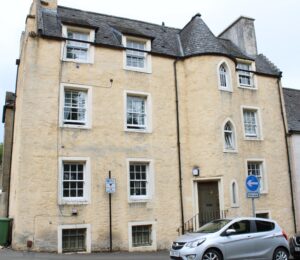
Even in examples where the harling has been removed to expose the raw stone, such as in the house below, centuries of previous lime harling have proven beneficial in protecting the stone and preventing weather damage.
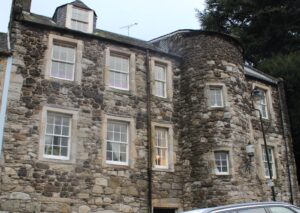
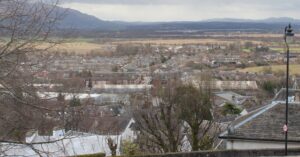
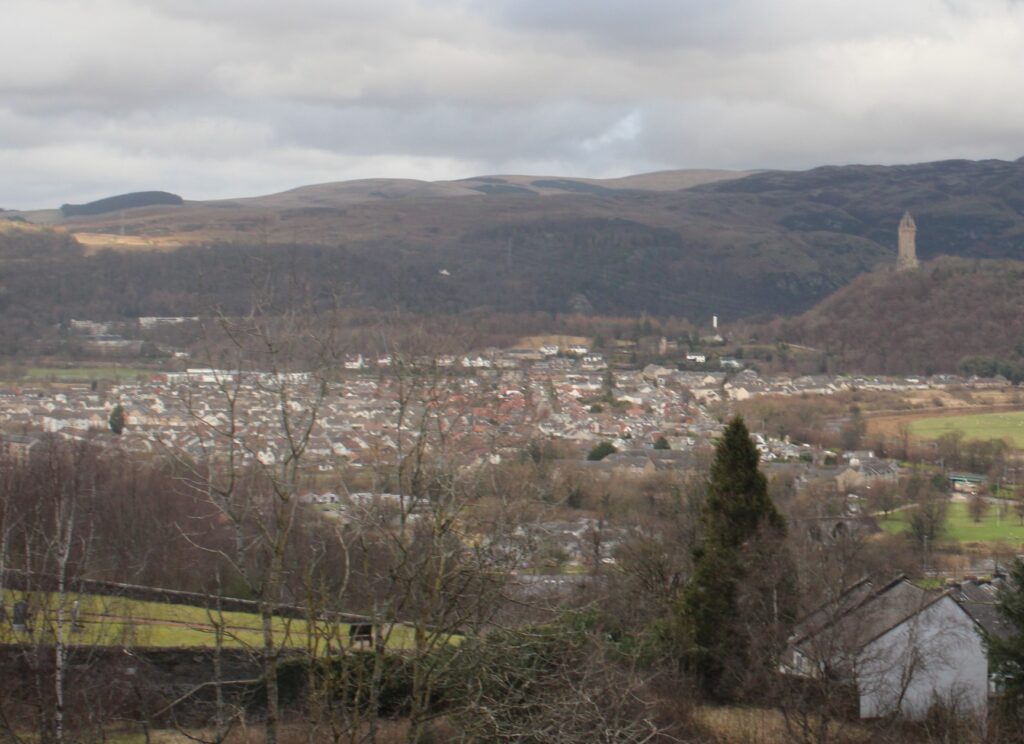
Our tour ended at Stirling Castle itself, looking out over the city from its highest point. Constructed from stone from both local quarries and quarries across Scotland and the north of England, Stirling provides an excellent example of the beautiful diversity of historic stone buildings, how they can be maintained well, and what happens when they are neglected. It was clear that a serious financial and time investment in traditional skills, the quarrying sector, and tenement maintenance are needed to preserve Scotland’s historic stone buildings for generations to come.
Find out more about stone defects and how to fix them on our dedicated webpage.