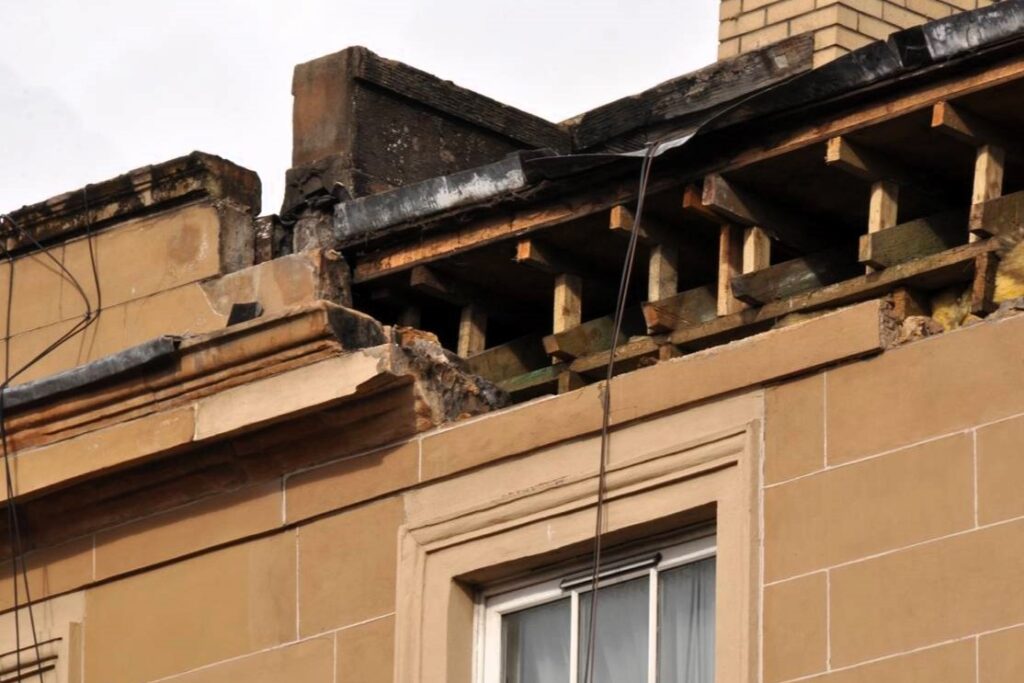
The Tenements (Scotland) Act 2004 imposed on every owner a duty to maintain the parts of the tenement that provide support and shelter. This would apply to leaking roofs, rot in structural timbers, leaks around individuals’ windows etc. and possibly in situations where an owner is proposing to remove structural beams.
This duty can be enforced by other affected owners regardless of what the titles state and does not require majority agreement, though this should be sought wherever possible. One of the main disadvantages of utilising the Duty to Maintain is that you (or you and the other willing owners) may need to cover the maintenance costs first and seek to recover these costs at a later stage under section 10 of the Tenements Act.
This is a very powerful legal protection for your tenement but you may need to seek help to enforce it.
Maintenance must be reasonable – so, an individual owner may argue that it is not reasonable to maintain given the dilapidation of the building and the high cost repair. If you do not agree, you can ask the Sheriff Court to decide who is right under section 6 of the Tenements Act.
For example, if a tenement is particularly run down and you are wanting to replace the whole roof with a brand new roof, the Duty to Maintain is unlikely to extend to a whole roof replacement given the run down nature of the tenement.
This is supported by a recent court case of Lacey v McConville [2020] SC EDIN 35, in which a sheriff ruled that the Duty to Maintain could only be used to enforce patch repairs, even though this appeared to not be in the owners’ best interests as a whole. Other courts may decide differently based on a different set of facts.
How to enforce the Duty to Maintain
When an appropriate repair is required:
- remind owners of their legal duty – if talking to your co-owners has no effect, writing may be more effective
- adapt the downloadable Duty to Maintain letter to suit your circumstances
- if your co-owners don’t respond, ask your council for help – they may be able to serve a Work Notice or use the Missing Shares provision (note these can only be used prior to work being carried out)
Download the Duty to Maintain letter template
If your council can’t or won’t help, this is what you do:
- confirm that you have followed proper procedures
- instruct or carry out the work
- send the bill to the other owners, calculating their shares appropriately
- when you send the bill, be clear that you are willing to take legal action to recover your costs
- take legal action to recover costs if required
- for repairs under £5000, you can use the Simple Procedure
- for repairs over £5000, you can take an ‘Ordinary Cause’ action and will need a solicitor
- you may also wish to consider serving a Notice of Potential Liability for Costs
Liability for costs
Under the Duty to Maintain rules, each owner is responsible for the repair costs just as they would be if repairs were carried out under the standard rules or by the factor (i.e. the shares are the same as any other repairs). However, under the Duty to Maintain rules, the other owners only become legally responsible for their share of the costs once the maintenance is completed. This differs from the usual process where owners become responsible for costs once a scheme decision is made. Though this distinction might seem minor, it can make quite a significant difference in an owner’s ability to use the Duty to Maintain rules.
For example, if a scheme decision is taken, you or your factor may be able to use debt recovery options to seek upfront payment of the repair costs if required (and there isn’t a sufficient enough float or building reserve funds to meet the costs). However, under the Duty to Maintain rules, the maintenance must be completed first before the legal obligation on the other owners to pay arises. This means that you can seek payment, however, there is no legal obligation for someone to pay you until the work is complete. If you are instructing a contractor, the timing of their payment terms could mean that you are left out of pocket for quite some time.
Therefore, it is important to consider the financial implications of using the Duty to Maintain rules before opting to use them.
Getting help
If you have got as far as sending the bill for a repair but got no response and your council is unable to help, you should consider consulting a solicitor before taking legal action.
Legal reference
Duty to Maintain