
An owners’ association is a formal arrangement between the owners, complete with a constitution, and agreed rules and procedures. Having one in your building can make a big difference when it comes to managing repairs, maintenance, and the overall upkeep of your building.
The Scottish Law Commission is currently examining a recommendation, originally made by a Scottish Parliament Working Group in 2019, to make homeowners’ associations compulsory for tenement owners. Homeowners’ associations can make it easier to carry out repairs and maintenance in tenement buildings, particularly in common areas.
Since 2022, the Commission has carried out a scoping exercise, researched the kinds of maintenance arrangements already in place, and engaged with stakeholders concerning this recommendation. Early in 2024, they asked organisations for their views on the topic, and Under One Roof presented two responses. The first is a consultation response from the perspective of Under One Roof, and the second is a response informed by the views of tenement owners, which we gathered using a survey. Click here to read our consultation responses.
In August 2024, the Commission published a Discussion Paper, and by 2026, they hope that the Scottish Government will have produced draft legislation to this effect. Click here to find out more about the Commission’s Discussion Paper on compulsory homeowners’ associations.
Follow our guide to helping you set up an owners’ association in your building.
Note: In 2023, we put out a survey to owners to hear about their experiences of having an owners’ association. We’ve included quotes and top tips from that survey throughout this article.
Before diving in, it’s important to recognise the advantages of having an owners’ association. This can help to persuade the other owners in your building why it is a worthwhile thing to do.
What are the benefits?
- Improved communication among owners
- Ability to open a dedicated maintenance account
- Increased satisfaction with how your building is managed
- Faster and more efficient decision-making processes
- Stronger leadership and a single point of contact for repairs
Importantly, an owners’ association can make it easier to carry out repairs and maintenance that can keep your home warm, dry, and structurally sound, and help to maintain your property’s value.
Say your gutters need cleaning. This is an essential maintenance task that might cost a few hundred pounds. But if it is not carried out and the gutters get blocked and overflow, this may lead to damp that, in turn, causes structural damage and costs thousands of pounds to repair.
With an owners’ association, organising something like gutter cleaning can be simplified and mean the difference between a straightforward maintenance task or a disruptive and expensive repair.
“We were able to address key concerns within a few months and improve the shared areas within two years, with estate agents commenting we had increased values of properties by over 10%, and made rental flats easy to let where it had been difficult due to run down areas.”
As a starting point, get in touch with your co-owners and set up a WhatsApp group (or a form of group communication of your choice), so that you have a means of contacting each other. This can be useful for arranging owners’ meetings.
If you are struggling to contact all the owners in your building, check out this article.
If it’s a landlord that you are struggling to reach, have a look at our ideas for getting in contact in this article.
If you are a landlord overseas and want to set up an owners’ association in your building, you can find out details of your co-owners either on the Register of Private Landlords or the Land Register, or you may be able to ask your letting agent to assist you in the process.
Download our customisable flyer to send to your co-owners to get started.
“An important benefit is having a data-base of contacts, updated regularly, (and accessible only by office bearers) to enable immediate contact of owners for any repairs/emergencies/tenant problems.”
Top tip: “Do an initial survey asking whether the owners want [an owners’ association], whether they would pay an ongoing member’s fee into a pot for repairs, and what priorities they feel need addressing. This gives credibility to actions.”
Once you have contacted your co-owners and started a conversation about setting up an owners’ association, you may decide to make it more official and establish a set of rules. These can be outlined in a constitution.
Having a constituted owners’ association can help to ensure everyone is on the same page with how things are going to be run, and if you wish to set up a maintenance account, most banks will require that you have a constitution.
Your constitution should cover things like:
- The purpose and objectives of the association
- Membership criteria and subscription fees
- Roles and responsibilities of office bearers
- Meeting procedures and decision-making processes
- Financial management guidelines
- Process for amending the association rules
Download our template to get started.
Note: This constitution can be adapted according to the owners and is merely a template. There are currently no set guidelines on how an owners’ association should be constituted.
Top tip: “Document all developments in an open, clear, and concise manner.”
To ensure your owners’ association can run smoothly, it’s a good idea to have a dedicated committee led by key office bearers. The roles and responsibilities of these office bearers can be outlined in your constitution, but they should include:
- Chairperson: a trusted leader who represents the interests of all owners
- Secretary: an organised individual responsible for record-keeping and documentation
- Treasurer: someone ideally with a knowledge of using spreadsheets to manage the association’s accounts
Depending on the size of your association, you may also want to assign additional committee members to share responsibilities and provide opportunities for involvement.
Top tip: “Know your title deeds inside out.”
One of the functions of an owners’ association is to manage funds for building repairs and maintenance. A maintenance account serves as a dedicated account for funds that can pay for or go towards future repairs or ongoing maintenance.
Generally, the account holds the float contributed by each owner, as well as any advance payments made towards upcoming repairs.
Most banks will require a constituted owners’ association before allowing you to open such an account – often banks will refer to these accounts as charity, non-profit, or community accounts. We suggest searching online to find a bank that provides an account suitable for your association.
This guide from the Scottish Council for Voluntary Organisations has some useful information about such accounts.
Download our document on suggested rules for running a maintenance account. This can be adapted as needed for your building.
Top tip: “Pay a small annual fee into the association account to cover expenses.”
While setting up an owners’ association requires some initial effort, the long-term benefits of improved building management, increased property value, and a stronger sense of community in your building make it well worth the investment.
To keep your association running smoothly, effective communication and cooperation among owners is key. Encourage open dialogue, share meeting minutes and updates regularly, and be prepared to address concerns or conflicts that may arise.
See our articles on effective meetings and difficult conversations for tips on how to ensure you get the most out of owner meetings and navigate potential challenges.
Top tip: “Ensure all owners are aware of the consensus and that the majority are supportive of maintenance issues. Communication is key!”
Can an owners’ association be fully constituted with a majority of owners’ signatures, or does every owner in the building need to agree for it to be set up?
Currently, legislation does not explicitly outline rules for owners’ associations (OAs), only default rules on how to proceed with repairs. However, property titles may establish specific regulations concerning OAs, such as requirements for achieving quorum and other operational aspects. Make sure to check your titles first to see what applies to your building. Additionally, banks may have their own set of requirements for non-incorporated charities to open accounts.
What if I don’t want to be a part of the owners’ association in my building?
If you don’t want to be part of the owners’ association in your building, that’s okay; however, keep in mind that by opting out, you’ll miss out on some of the potential benefits, like improved communication with your co-owners and a more streamlined process for carrying out repairs and building upkeep that will ultimately help to maintain your property’s value. Additionally, decisions made by the owners’ association decisions could still impact you as an owner, even if you’re not directly involved.
What can I do if I’m not happy with how my owners’ association is being run?
If you’re not happy with how your owners’ association is being run, there are a few steps you can take. First, foster open communication – share your concerns, request transparency like meeting minutes, and be prepared to address issues constructively. Review your association’s constitution and if procedures are not being correctly followed, you may be able to raise objections or propose changes.
Make sure continue to participate actively and make your voice heard. Consider putting yourself forward for a leadership position if you are dissatisfied with the current office bearers. The key is to maintain open communication, follow established processes, and escalate appropriately if concerns persist.
Which banks offer the type of account an owners’ association requires and what is this called?
There are several banks which offer the type of account required, and they are often referred to as charity, non-profit, or community accounts. This guide from the Scottish Council for Voluntary Organisations has some useful information. Most banks will require a constituted owners’ association to open such an account.
Do we have to register our owners’ association?
No, it is not necessary for owners’ associations to be registered.
If you have further questions about setting up an owners’ association, or another tenement-related query, use our free ‘Ask an expert’ enquiry service.
We asked for information and tips from tenement owners who have successfully set up an owners’ association. We received several responses and one owner agreed to be interviewed about their experience.
There were mixed responses to this survey but overall, most owners found the experience of having an owners’ association a positive one.
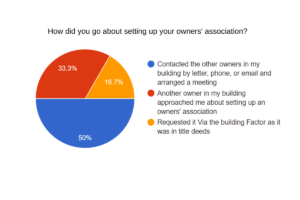
How did you go about setting up your owners’ association?
How long did it take you to establish your owners’ association, from the initial idea to its formation?

How would you describe your experience of having an owners’ association so far?
 Below are the key takeaways and some tips for setting up your own owners’ association.


The positives
“We were able to address key concerns within a few months and improve the shared areas within two years, with estate agents commenting we had increased values of properties by over 10%, and made rental flats easy to let where it had been difficult due to run down areas.”
“An important benefit is having a data base of contacts, updated regularly, (and accessible only by office bearers) to enable immediate contact of owners for any repairs/ emergencies/ tenant problems.”
“We talk and share discussion about what the building needs.”
The challenges
“Frequent hostile responses from absent owner landlords.”
“The factor (local authority) is also majority owner and does not want other owners involved.”
“It’s given us the mechanism to get maintenance done by having an official structure. The downside is that out of four tenements only three co-owners have joined. This means that as long as there is a majority vote, the non-joiner has to comply. We send them a copy of the meeting minutes as a courtesy but they think that if they don’t join they don’t have to comply despite what the title deeds specify. Disputing payment with this one co-owner delays work which pushes up costs.”
“It is a very positive experience seeing the results of the work and getting positive feedback. However, after a while it is difficult to get people willing to be office bearers.”

Interview with Derek
Of those who completed the survey, we were able to interview Derek to find out more about his experience of having an owners’ association in his building.
Derek moved to his property in 2003, a few years after the building had been converted into four flats. He was familiar with the Tenement (Scotland) Act and the Tenement Management Scheme from his work, so he knew about and understood the potential benefits of having an owners’ association. Additionally, he recognised the need for one in his building:
“There were no arrangements for factoring and repairs had been carried out by a handyman, cash in hand, who was a pal of one of the owners. No records. There were constant roof leaks, so I suggested we form an owners’ association, which the other owners agreed to.”
Derek approached the other owners and suggested they either needed to appoint a factor or set up an owners’ association. They agreed to the latter and the first step was to set up a maintenance account to cover repair costs, which they managed to do by setting up a business account with the bank.
“We agreed a monthly contribution to a maintenance fund, which except on one occasion has covered our maintenance costs. The one exception was a major roof refurbishment which came to nearly £100K.”
The running of the association has been relatively smooth, but Derek pointed out that if their building had more people or more problems, it would be more challenging, and he’d consider suggesting appointing a factor instead. He has also had to take on a fair bit of the organisational work to keep the association running.
However, for the most part, the association has been a success as repairs and maintenance have been completed relatively easily. The association communicates largely by email and if a new owner joins the building they are informed in advance of the owners’ association and their responsibilities.
“Cooperation is essential. We have been fortunate in that it has worked well for us.”
It is clear from our interview with Derek and the survey responses that having an owners’ association can be challenging. But they also highlight the benefits of having one when it comes to maintaining and managing a tenement flat, such as improved communication, making the common repairs process easier, and ensuring there is the money readily available to cover repair costs.
Learn more about owners’ associations.