Most flats in Scotland are heated with gas boilers and a significant minority are heated with resistive electric systems such as storage heaters. A small but growing number are heated by heat networks or heat pumps. This article sets out the future direction of heating for tenements and explains the types of heating system available.
The future of heating
Scotland has made a legally-binding commitment to reach net zero greenhouse gas emissions by 2045 with interim five-yearly targets from 2030. Buildings account for around one fifth of these emissions, mostly from burning gas for heating. So replacing boilers with green alternatives such as heat networks or individual electrified heating systems is a major change affecting most tenements in the years ahead.
Chris Carus, from Loco Home Retrofit CIC, set out the main options and considerations in this webinar.
Types of heating systems
1. Gas boiler
Low operating costs but expected to be phased out by 2045.
Gas boilers installed since 2005 have been legally required to be of the more efficient ‘condensing’ type which extract heat from the combustion gases. If well installed with the right size radiators and controller these can achieve 93% efficiency, meaning one unit of gas gives 0.93 units of heat. Older, ‘non condensing’ boilers may achieve as little as 55 to 78% efficiency.
So if you are unable to connect to a heat network or upgrade to a future-proofed heating system such as a heat pump it may well be worth replacing a non condensing boiler with a new condensing unit.
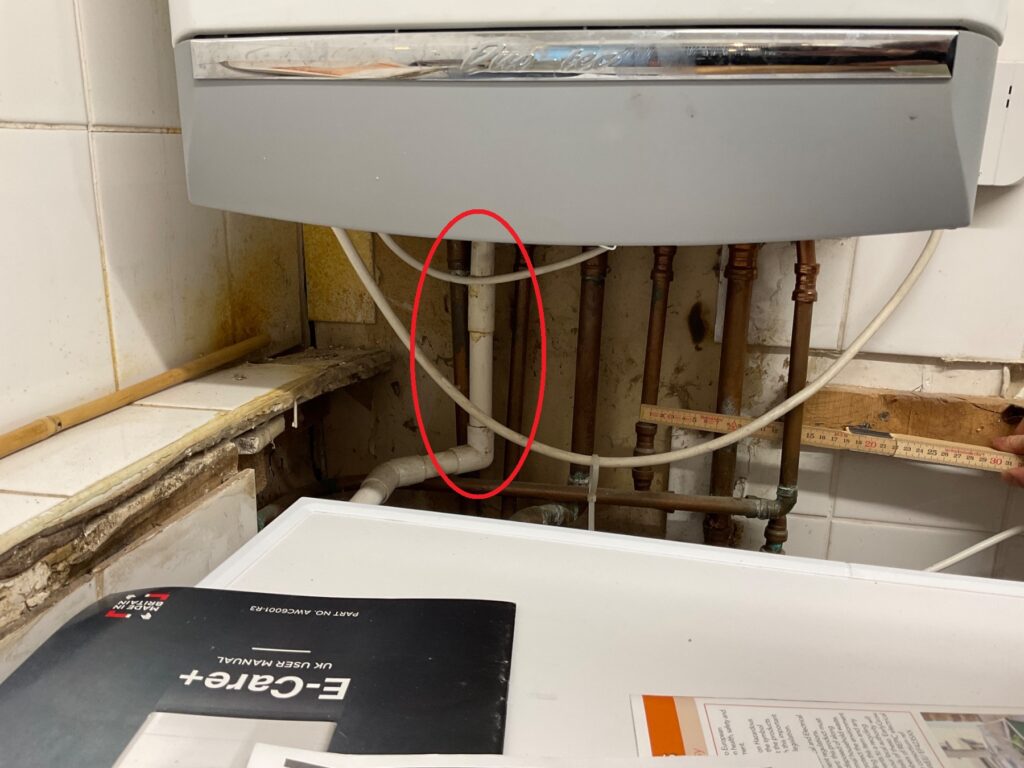
If you see a plastic pipe coming out of the bottom of your boiler and leading to a drain pipe, then it is most likely that this is a modern condensing type boiler.
Unfortunately, due to lax regulation in the Scottish Building Standards, most condensing type boilers are installed in such a way that they do not operate efficiently. A field study found the average performance is 83%, not the 93% that features in boiler marketing. See section C below to see how you make your boiler operate more efficiently, saving up to 10% on your gas bill.
Poorly installed boilers can kill through carbon monoxide poisoning or explosions so be sure to use a reputable and qualified contractor.
What about hydrogen?
It is extremely unlikely that hydrogen will be supplied through the gas network because it is much more hazardous than natural gas and it is much more expensive than alternative heating systems. Boiler companies have been advised not to mislead consumers with false claims about hydrogen ready boilers.
Optimise your boiler
If you’re not able to invest in a new future-proofed heating system or its unclear whether or when a heat network will arrive in your street, there are steps you can take to reduce bills.
- Heat occupied rooms, not the whole property.
Thermostatic radiator valves (TRVs) will turn a radiator off when a given temperature is reached. All the TRVs ina room should have the same setting. If you turn a TRV down, be sure to close the door to that room, so it is not heated by radiators in other rooms.
Avoid turning off too many radiators using TRVs as it may make the boiler operate less efficiently
- Turn down your boiler flow temperature
Follow the simple instructions on Nesta’s Money Saving Boiler Challenge to get your boiler operating efficiently.
https://moneysavingboilerchallenge.com/
- Better boiler controls and right-sized radiators
To make your boiler heat rooms effectively and efficiently from autumn to spring, without having to fiddle with controls it may be necessary to get larger radiators and a controller that automatically adjusts to the outdoor temperature. Speak to an independent adviser such as Loco Home to find out more.
2. Electric Storage Heaters
Inexpensive to install. Medium operating costs.
In a storage heater, a resistive element (same tech as a toaster) heats up ceramic blocks using off peak electricity, usually overnight. During the day heat is released from the blocks. The unit is insulated and the rate at a flap controls the rate at which heat is released through the day.
Resistive heating is 100% efficient, meaning one unit of electricity generates one unit of heat. However storage heaters are hard to control. The heater may release more heat when it is not needed, such as when the occupants are absent during the day, meaning more heat may be produced than needed. The low off-peak price of electricity generally compensates for this lack of control.
Modern ‘high heat retention’ storage heaters are better insulated and automatically control the flap according to indoor temperatures. They also automatically adjust the overnight charge according to how much heat was needed over the last few days, therefore responding to the changing of the seasons.
If the heater’s overnight charge runs out before the end of the day, it may be necessary to heat the room with an additional ‘direct’ heater using expensive peak rate electricity. New technology is emerging to cost-effectively improve the consistency of indoor temperatures by using smart tariffs and an afternoon storage top up.
Compared with gas boilers, storage heaters are currently penalised in Energy Performance Certificates as they are more costly to operate.
While the Scottish Government has not yet published any regulations, it is likely that storage heaters will be recognised as an acceptable, future-proofed clean heating system.
3. Instant Electric Heaters, including Infrared
Inexpensive to install. Highest operating costs.
Electric room heaters, ‘smart’ electric radiators, electric boilers, oil-filled radiators all work in the same way as a toaster – by passing electricity through a resistive element. They all achieve exactly 100% efficiency – one unit of electric energy produces one unit of heat energy.
Infrared panels work the same way and also achieve 100% efficiency but they have a much larger surface area meaning they can operate at a lower temperature. This has the effect of heating objects through radiation, and heating the air less (through convection). Manufacturers claim that heating only the occupants and objects in the room delivers a cost saving. However a government review found a lack of evidence of acceptable comfort levels, and highlighted that lower air temperatures may increase the health risks of condensation and mould.
Due to the high price of peak rate electricity, heating directly with resistive electric heaters can be extremely costly.
4. Air source heat pump
Can be expensive to install. Lowest running costs, dependent on quality of installation and user behaviour.
Heat pumps collect low temperature heat from the outside environment and transfer it to the indoor environment through a compressor. They can achieve efficiencies of well over 300%, meaning one unit of electricity provides 3 units of heat.
Provided that the design and installation of the system, including radiators and controls, is carried out to a good standard then operating costs can be lower than heating with a gas boiler. Bills can be further reduced through the use of smart ‘time of use’ tariffs if you have a smart meter. With the phasing out of gas-powered electricity generation in the years ahead, electricity is expected to become less expensive relative to gas.
However the heat pump sector is not yet mature in Scotland and households are at risk of poor outcomes if an installer is not competent.
Types of heat pump
Most domestic heat pumps in Scotland take heat from the outdoor air and heat the home via water-filled radiators. These are referred to as ‘air to water’. This can be costly to install as it is often, but not always, necessary to upgrade radiators and pipework, although this isn’t always necessary.
However another system called ‘air to air’ is much less costly to install than air to water. This system delivers heat through warm air. These systems can also provide cooling in summer. This is the most common type of heating in the world’s most heat pump-ed country, Norway.
There are many variations of these heat pump systems, including systems linked to ventilation systems. However the market is not well developed in Scotland beyond the new build sector.
Do I need to upgrade insulation?
Regardless of the heating system you have it is always advisable to install low cost insulation measures like draught proofing, loft and cavity wall insulation as these investments will reduce your ongoing energy bills. However it is not necessary to add insulation for a heat pump as there is always a heat pump powerful enough to cover the property’s heating requirements. Flats in Scotland typically require a heat source of around 5 to 10kW.
The advantages of reducing heat loss with additional insulation like double glazing, ground floor insulation or wall insulation are i) you will enjoy a superior level of thermal comfort, and ii) the cost and disruption of radiator and pipework upgrades may be reduced, and iii) the outdoor unit may be smaller. However the cost savings in avoided radiator upgrades are quickly outweighed by the cost of additional insulation.
Can I get a heat pump in a flat?
In a word, yes. However disruption and costs will vary depending on the characteristics of the property and the technology you select.
5. Heat Network
Heat networks have long provided a means of distributing heat from a central source across a building in shared ownership, campus or much wider area. Today, the primary driver for the further deployment of heat networks is the national obligation to achieve net zero greenhouse gas emissions.
While heat networks can be developed at relatively small scale, even as few as 50 properties, networks are most likely to be developed in densely built up areas like city centres. Local Authorities are required to identify zones for potential network development. Consult your local authority’s Local Heat and Energy Efficiency Strategy to find out how your flat is likely to be affected.
There are two main types of heat network, known as fourth and fifth generation networks.
In fourth generation networks, heat is produced centrally in an energy centre, such as an Energy from Waste plant, or very large river-source heat pumps. Heat is then distributed to properties through insulated pipes that are usually buried under the round. Heat is passed from this network to each property through a metered and billed heat exchanger. The system of pipes and radiators in each connected property is very similar to that in any building currently heated with a gas boiler. Hot water taps is usually produced instantly at the heat exchanger.
Most large scale district heat network projects being considered by local authorities are fourth generation.
In fifth generation networks, low temperature heat, such as water from boreholes, is distributed to each property. An individual heat pump in each property then increases the temperature and produces hot water using either a cylinder or heat battery. This type of network can be suitable for smaller scale projects and can be expanded in stages. There is an increasing number of local scale projects using fifth generation approaches in Scotland including entire tower blocks.
Under One Roof hosted industry experts to talk about the development of heat networks in Scotland.
6. New technology
New technology is emerging all the time.
Electric boilers with built in electric boilers are a kind of storage heater. However electric batteries are more expensive per unit of energy stored, than storing heat in bricks (like traditional storage heaters) or water (like off-peak immersion tanks). Therefore these have very limited application unless the batteries are very large.
The Zero Emission Boilers is like a storage heater, but rather than having electric units in each room, a central storage unit supplies a wet heating system of water-filled radiators.
Thermal stores such as phase change material thermal batteries provide a more compact way of storing heat for hot water taps than a hot water cylinder and are a good way to use off peak electricity. However do not store enough heat for space heating for most types of flats.
New kinds of heat pump including thermoelectric and acoustic types are in development in the media but have not yet been demonstrated at scale.