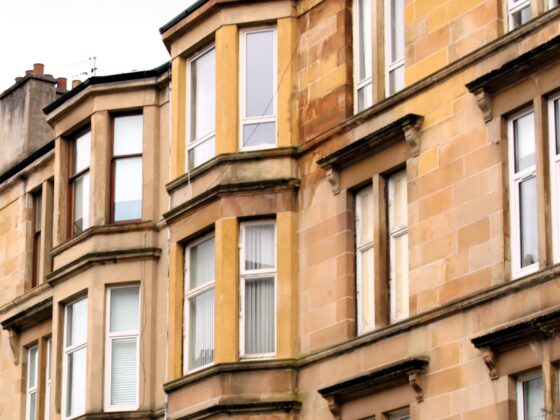

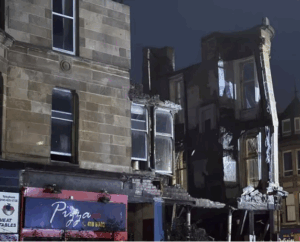
Shortly after midnight on Saturday 12th July 2025, a traditional sandstone tenement building in Glasgow collapsed. Nobody was living in the building, on the corner of Kenmure Street and Albert Drive, and nobody was injured by the falling masonry, but the collapse has impacted those living in neighbouring buildings, who had to be evacuated in the early hours of the morning.
It has been reported that the building was in a derelict state, having been badly damaged in a fire in 2020. Images of the collapsed façade, missing roof and broken windows have prompted Under One Roof to ask- are you insured against major damage to your tenement, such as fire and collapse?
If you own a tenement flat, you are obliged by law to have adequate insurance, both for your flat and the common parts of your building, to cover the costs of major damage to your own or an adjacent building. This law, introduced in the Tenements (Scotland) Act 2004, protects people from having to cover all the costs of severe damage from their own pocket.
Since it is impossible to rebuild just part of a tenement building, it is vital that everyone in the building has suitable insurance. If not, the uninsured (or under-insured) homeowner could lose their home, and be liable for damage done to the common areas of the building from their own pocket. So having the correct insurance, with sufficient coverage for both your flat and the common areas, is crucial.
In some tenement buildings, owners agree to take out a common buildings insurance policy, which covers the reconstruction of the flats and common areas of the building. This can help owners to save money, as in the event of serious damage, they can make a single claim and only pay one excess. Block insurance can also provide coverage for the unique quirks of your building, such as any unusual common areas. Bear in mind that your titles may require you to pay into an existing block policy.
Regardless of which type of insurance you choose, you must make sure that it provides adequate coverage for every part of your building, in every circumstance. Make sure that your insurance covers all the common areas, and includes cover for fire, escape of water, flood, storm, and subsidence and your liability as a property owner. It is also useful to include cover for legal expenses (sometimes call Family Legal Protection), often an add on or optional extra, but could prove invaluable. It covers the cost of pursuing legal disputes for different scenarios with the aim to help you recover compensation, damages or other legal remedy and gives you access to a legal expenses helpline. You should also ensure that your policy provides cover for the cost of alternative accommodation if following an insured loss you are no longer able to live at the property.
Your insurance premium should be based on the rebuilding cost of your property, not on the purchase cost of your flat. This is because, especially for traditional stone buildings like the one which collapsed in Glasgow, the cost of rebuilding can be much more than the purchase cost of your flat.
You can check that you are insured for the right amount by getting a Building Reinstatement Valuation, conducted by a qualified surveyor, every three to five years to assess the rebuilding cost for your building.
So, if images like the one of this recent collapse have got you worried that you may be uninsured or under-insured against major damage to your home, check out Under One Roof’s dedicated guide to Buildings Insurance for tenement flats, here.