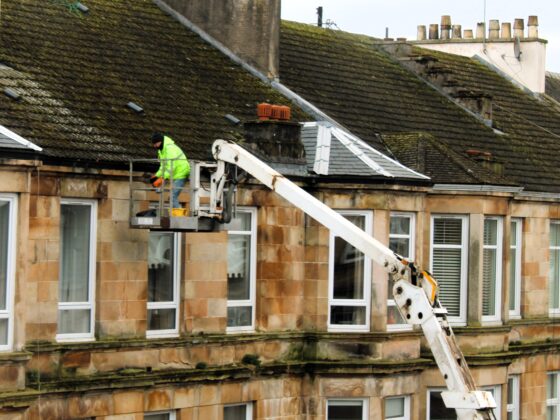
Slate roofs were commonly used until the 1960s when concrete tiles became more popular. Scottish slate quarries closed at this time but it is still possible to source good second hand slates for roof repairs. Reslating a roof will cost a little more than replacing with tiles but will have a longer life. Slating may be required in a listed building or in a conservation area.

Slate problems
- it can be hard to spot the source of a leak as rainwater can run down roofing felt before penetrating below
- slates can break, particularly when walked over by people installing TV aerials and satellite dishes
- slates can work loose, either because the fixing hole is too big or the nail is rusted or works loose
- failure of the sarking through rot or previous repairs will also cause nails to work loose and slates to slip
- if the ridge flashings, hip flashings or copings are missing, the top row of slates is likely to work loose
 A bad case of slipped slates. This is due to the ridge being missing.
Repairing a slate roof
Annual roof checks can prevent more major repairs and should include checks of slating, flashings and gutters.
Existing slated roofs can usually be repaired fairly easily provided the slates have been head nailed. The slates are eased to the side, allowing a new slate to be inserted and re-nailed. This type of repair is not possible where slates have been centre nailed or side nailed. It is likely that some slates will need to be replaced.
 Slipped and missing slates. This roof requires attention.
Replacing a slate roof
You would be wise to appoint an architect or surveyor if you need to prepare a specification and tender for the works.
What to look for in a quotation
Sarking
- lifting of bottom rows of sarking to check for rot in rafter ends – this is a vulnerable area as gutters often overflow and the water then rots the timber wall plate and rafter ends
- rotten sarking boards should be replaced with the same timber thickness as the existing boards
Underfelt
- provides secondary protection in case a slate slips
- breathable roofing felt laid on top of sarking to provide temporary cover during reslating and encourage ventilation in the attic space
- dressing of felt into the gutter. If it is not UV resistant, then it should be set over a UV resistant eaves guard to prevent breakdown of felt in sunlight.
Replacement slates
- re-use of as many slates as can be salvaged – these will need to be redressed to size
- use of salvaged Scottish slates from elsewhere if possible
- replacement with 9mm thick riven Spanish Cupa or Burlington Slate (thinner slates are not advised as they are designed to be fixed to timber battens and being thinner, will not match the existing slates)
- low pitch roofs (25 degrees or less) require larger slates.
Slate fixing
- nailing with 50mm copper, aluminium or stainless steel nails (more rust resistant than galvanised nails)
- double slating of first course of slates
- double nailing of slates at exposed edges (valleys, verges, ridges)
- side (cheek) nailing every third course (reduces risk of slates lifting in high winds)
- side or double nailing to steeply pitched roofs (on turrets or mansard roofs)
- centre nailing of larger slates which require two fixings
- in a typical roof pitch of 30 degrees, the headlap (distance between the nailhole of the lowest slate and the foot of the top slate) should be 75mm at eaves reducing to 50mm at ridge
Associated work
- fitting of roof anchors to improve safety for future maintenance and inspections
- skews, chimneys, ridges and hips, valleys, dormers, cupolas and skylights are also likely to require attention and should be dealt with while you are already paying for scaffolding
Note: if reslating will take longer than two or three months, then additional tarpaulins are advised as breathable felts can let water through after time. If there are lots of lead work and rooflights to be repaired, then a complete temporary cover to enclose the whole roof should be considered to avoid damage to top floor flats.
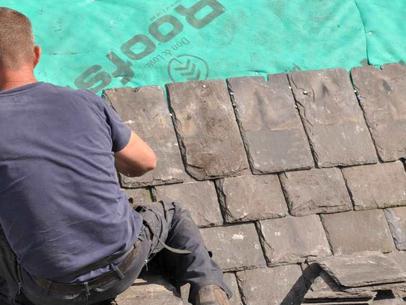 Recycled slates being side nailed
Professional help recommended?
You would be wise to appoint an architect or surveyor if you need to prepare a specification and tender for the works.
Who pays?
Roof repairs are normally a common responsibility.