Whether it’s expanding into the loft or making internal alterations, it’s important to ensure any flat alterations comply with your legal obligations as an owner and do not compromise your building’s structure.
1. Check your titles
As with repairs, before making any changes to your flat, check your property titles. These may outline details of common ownership, permissible uses of your property, and any restrictions on modifications, such as certain structural alterations or whether you need to keep to a common scheme of paint colours.
2. Obtain consents and permissions
Depending on your titles and the nature of alterations, various consents and permissions may be required. If proposed alterations go against your titles or encroach on common property, you will need to get consent from your co-owners.
If you are looking to enlarge your flat or make structural alterations, such as to the roof or walls, you will also likely require planning consents from your local authority and/or a building warrant, depending on the type of work. Check your local authority’s website for specific information relevant to your area.
If you live in a listed building or conservation area, there may be further restrictions on what you can and can’t do when altering or improving your flat. For example, if your building has sash and case windows, you may be required to keep this style if replacing them.
3. Consider internal changes and structural integrity
It’s essential to consider the structural integrity of your building when planning internal changes to your property. Flat owners are legally prohibited from interfering with any part of the property that provides support and shelter to the building.
This means that if a loadbearing wall, for example, is demolished, alternative structural support must be provided. Additionally, any alterations which leave openings in walls that let damp into the building must be repaired swiftly. To make such alterations, consent from co-owners is required, as well as a building warrant.
Other considerations when making internal changes include being mindful of sound insulation, flooring choices, and potential disturbances to neighbours. For example, putting in a kitchen or living room above or below a bedroom could be antisocial and lead to noise problems.
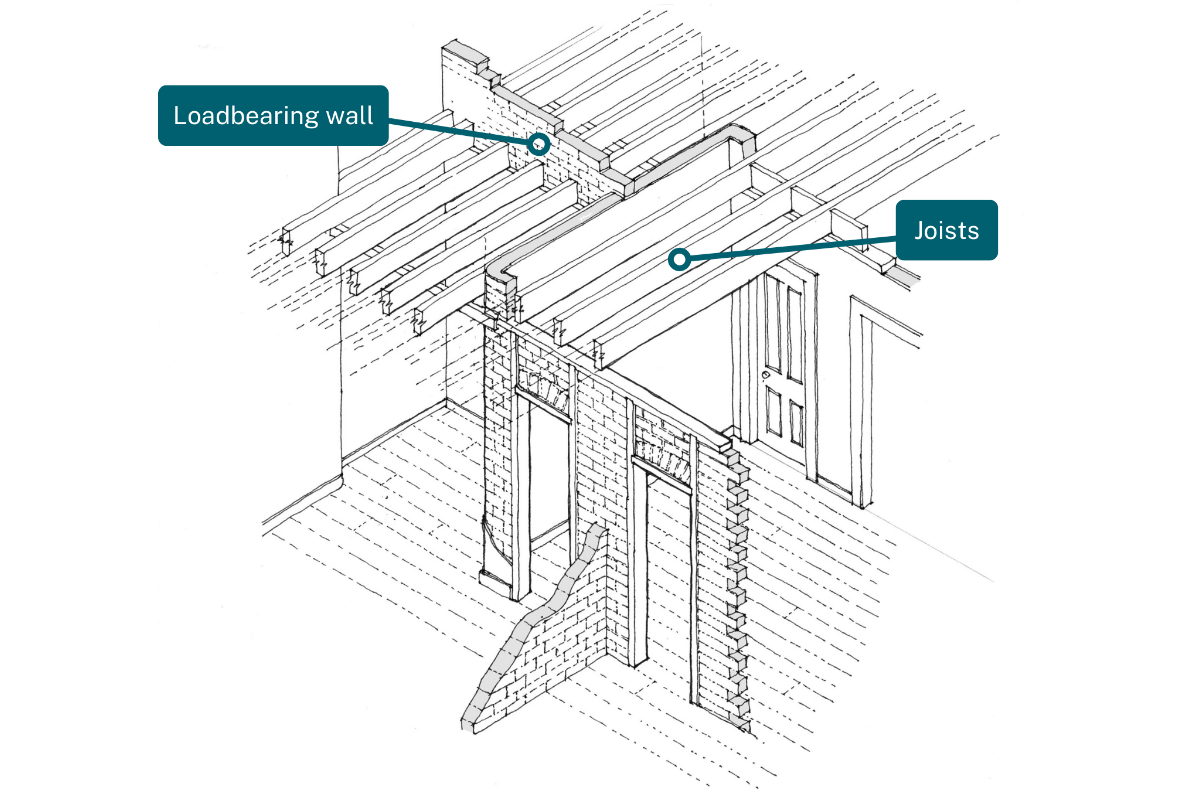 Illustration by John Gilbert showing the internal structure of a tenement flat.
4. Clarify owners’ responsibilities: floors and ceilings
Floor joists are an important part of the structure of your building, so major repairs to these should be treated as common repairs. Floorboards, floor coverings, and ceilings are generally regarded as individual repairs – unless your titles say otherwise.
However, if an owner cuts into floor joists in such a way that their structural integrity is affected, this is in breach of their Duty to Maintain. In this case, the individual could be considered liable for the cost of repairs.
5. Clarify owners’ responsibilities: loft extensions
Ownership of the loft space can vary, depending on your titles. Often it belongs to the flat immediately below; however, some titles may state that the loft is commonly owned. If your titles do not state who owns the loft, it belongs to the top floor flat owner.
For loft extensions, the top floor flat owner would need to obtain:
- planning permission (to which other owners can object)
- a building warrant
If in doubt around ownership and loft extensions, seek legal advice.
 Illustration by John Gilbert showing the internal structure of a loft.
6. Seek help from structural engineers
If making structural alterations to your property, it’s important to enlist the help of a structural engineer. Search online through the Institute of Structural Engineers or on findanengineer.com. Check that they have experience of working in tenements and can supervise contracts.
Conservation-accredited engineers do not necessarily charge higher fees and can be found through the Conservation Accreditation Register for Engineers (CARE).
7. Uphold common responsibilities
If alterations have been made, it’s important to uphold your obligations as a flat owner. For example, even if a loft extension has been added, roof repairs remain a common responsibility.
All flat owners have a legal Duty to Maintain the parts of the building that provide support and shelter, including their individual flat, and this must be taken into account when making any kind of alterations.
If you are planning to make internal changes or structural alterations and are unsure of ownership details or your responsibilities, it’s best to seek legal advice prior to carrying out works.