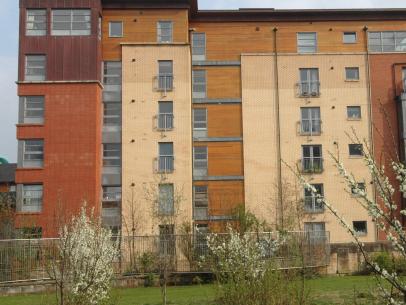
Mortgage lenders now require that those buying flats with cladding to provide a satisfactory EWS1 certificate.
An EWS1 certificate can only be provided by a qualified fire engineer and initially there just weren’t enough of these with adequate insurance to provide all the surveys needed. The professional indemnity insurance these fire engineers required had to be enough to cover the complete cost of rebuilding ALL the properties they have surveyed and any potential loss of life that might occur in such a fire. This is clearly a huge sum of money and the required level of cover is extremely hard to get.
In Scotland, there is an additional problem in that every flat owner needs to get their own EWS1 certificate (in England and Wales, people lease their flats rather than buy them freehold (outright), so just one EWS1 certificate can cover a whole block).
When it comes to replacing cladding, there has been a big debate about whether 100% of owners need to agree that the work is essential before contractors can start work on this essential safety work.
Solving the problem in Scotland
The Cladding Remediation Act 2024 was passed to help deal with these problems. This Act has four important provisions.
- The establishment of a Cladding Assurance Register which is intended to give evidence to mortgage lenders that a building is safe to lend on.
- Powers for the Scottish Government to arrange surveys of the fire risks associated directly or indirectly with external cladding in each building. These surveys are called Single Building Assessments (SBAs) and ‘additional work assessments’.
- Power to carry out remedial works which are found to be required under the SBA and additional works assessment.
- Setting up a of Responsible Developers Scheme.
The Act also gives the Government other powers to get relevant information, require access, evacuate unsafe buildings, and to evacuate buildings to carry out remedial works.
The provisions of the Act mean it is no longer possible for a minority of owners to hold up essential surveys and safety works.
We are still waiting to hear some of the details of how all this will work (as of August 2024).
Which buildings are covered by the Act?
Buildings covered by the Act must:
- contain at least one flat which is used as a dwelling
- have an external cladding system
- have the floor level of the top flat (excluding plant rooms) over 11 metres above lowest ground level
- been built between June 1992 and June 2022
It is estimated that there are around 780 high-rise (over 18 metres) and an estimated 5,000 mid-rise (11 to 18 meters) buildings in Scotland. It is thought that about 49% of high-rise buildings and around 10% of mid-rise buildings will require some sort of remediation.
The Cladding Assurance Register
This will be a list of buildings which have had a Single Building Assessment (SBA) carried out and there will be information on the works which are required or have been carried out to make the building safe. It will be a criminal offence to provide false information on this register.
The Single Building Assessment
Owners and occupiers of flats will be given seven days notice that an SBA (or additional works assessment) is to be carried out. There must be opportunities given for owners and occupiers to ask questions about the assessment before it starts. The person carrying out the assessment will have powers to enter the building, to bring equipment or other people into the premises, to remove items, and to carry out tests. The assessor must give at least 24 hours notice and come at a reasonable time of day. They cannot use force to enter premises but can get a warrant allowing them to do so if an occupier refuses entry or the premises are unoccupied. It will be an offence to obstruct the assessment.
Following the completion of the assessment, owners and occupiers are to be given information about the conclusions of the assessment in plain language and given an opportunity to ask questions.
Remedial works
The Scottish Government will have power to carry out remedial works identified through the SBA and additional works assessment. Owners must be informed that remedial works are to be carried out and given an opportunity to ask questions. Owners will be given 21 days notice of the works that are to be carried out and can appeal during this period. If, however, an immediate risk to life is discovered, the government has powers to step in immediately without giving notice.
It is hoped that most remedial works will be paid for by ‘Responsible Developers’ but if a developer is no longer in business or refuses to co-operate, the Government will pay the cost of remedial work.
The Responsible Developers Scheme
Developers who have a connection with buildings covered in problematic external wall cladding will need to become members of the Responsible Developer Scheme, or they will find it difficult to get building warrants or planning permission for new buildings. Responsible Developers will need to pay for Single Building Assessments and make financial contributions to the cost of remedial works.
Other powers
It will be an offence NOT to give relevant information to help carry out the SBA and maintain the Cladding Assurance Register.
Written notice of 14 days will be given where a building is to be evacuated, but in emergencies, where there is immediate risk to life, occupiers may just be given verbal notice of immediate evacuation. It will be an offence to re-occupy a building where evacuation has been ordered. Tenancy rights are not altered by an evacuation notice.
Will I still need an EWS1 form?
The Cladding Remediation Act is so new that we don’t yet know exactly how lenders will respond to the SBA and the Cladding Assurance Register, so it’s possible that purchasers might still require an EWS1 form to get a mortgage until things settle down.