Renders of various kinds are applied to walls to help protect them from the weather. They can also help moisture in the wall to evaporate. Render was also used on walls made of common brick.
Harling (or roughcasting) was originally applied to rough stone walls to protect them from the Scottish weather. It consisted of lime mortar mixed with small stones or shells being hurled or cast against the wall, and produced a rough-textured finish. Lime wash would be applied every few years to help seal small cracks.
Pebbledash is similar, but the small stones are thrown onto the render after it has been applied to the wall.
Smooth renders may be used on rebuilt brick chimneys to make them appear stone-like, with the mortar coloured and marked to mimic stone courses.
Modern thin-coat acrylic and silicone-based renders are used in external wall insulation projects, where they are applied to smooth-faced insulation. These renders are applied with additional glass fibre matt reinforcement to corners and openings. They are marketed as having ‘anti-crack’ resilience.
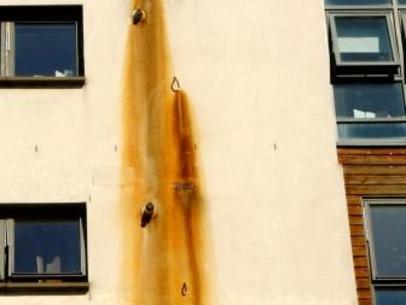 Staining from running overflow. These unsightly stains can be avoided by dealing with the cause of the overflow.
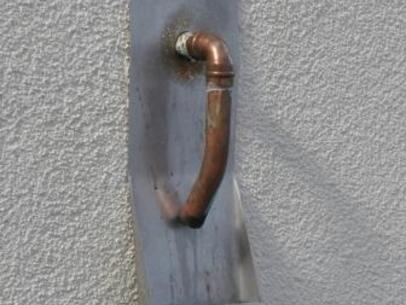 Overflow deflector. John Gilbert designed this simple deflector to throw drips from overflows clear of the wall.
Problems
Render mortars which contain too much cement can crack and craze. Water which seeps behind the mortar freezes and expands, leading to the mortar becoming loose or ‘boss’. This can be detected by tapping the mortar lightly with something like a chisel. ‘Boss’ render will sound hollow.
Hairline cracks are not a problem in themselves as long as the render is still firmly applied to the wall.
Cracking may occur around the edges of old patch repairs. This is often due to the patch being made with mortar that did not match the existing.
Check for plant growth in walls and staining caused by leaking gutters, downpipes, or overflows.
Repair and maintenance of rendered walls
When re-rendering a brick chimneyhead, the use of a stainless steel mesh fixed to the chimney can provide a good base for new render. Use of a ‘polymer modified render’ will reduce the likelihood of cracking.
On stone, lime-based mortars are better than cement-based mortars as they allow the stone to breathe, have better adherence, and are less likely to crack.
On brickwork, the joints should be chased out to provide a good ‘key’ for the render.
Make sure your builder uses a matching mortar when making patch repairs. A compatible aggregate should also be used. This may require the old render to be tested, especially if it is historic, lime-based, or your building is listed or in a conservation area.
Get cracks in render raked out and refilled with matching mortar.
If render looks poor, it can be recoated with a lime wash or, in more modern buildings, breathable exterior paint.
Make sure that the wall surface is as well protected as it can be, with copings and cills to keep water off the face of the building.
Professional help required?
Small patch jobs can be dealt with by a good builder, who should be able to match the type of render. Consider getting professional help with larger jobs as other repairs may also be required to prevent problems recurring or be more cheaply undertaken at the same time, rather than as a separate contract.